What to Know
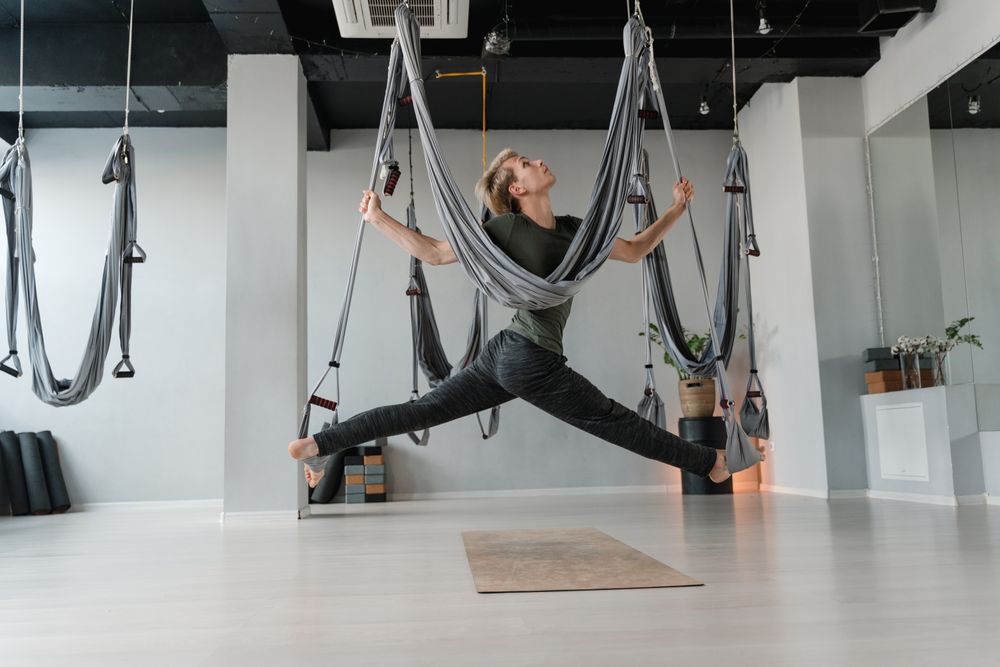
The most obvious feature of aerial yoga is that fabric can support the body. Understanding the movement, however, requires more than asking how much weight the hammock carries. Where that load enters the fabric, how widely it is distributed and how the body responds all matter. This Gizem Köymen guide introduces support points and weight transfer through the principles of grounded, supervised practice rather than instructions for suspended tricks.
Why fabric support differs from the floor
A firm floor provides a relatively stable surface. Hammock fabric changes shape, develops tension under load and moves in relation to its suspension points. A familiar body position can therefore require a different balance response when fabric height or tension changes.
Fabric tension acts along the material toward its attachments. Its effect should not be imagined as an upward force alone: sideways components can also guide the body toward a particular position. When the feet remain grounded, the floor and hammock share the load. Observing that relationship helps distinguish a deliberate transfer of weight from suddenly dropping into support or pulling against it without a clear purpose.
Contact area changes local pressure
The area receiving a load influences how support feels. A similar force concentrated over a smaller surface can create greater local pressure. Folded fabric or an edge gathering into a narrow strip may change the experience significantly. An instructor should explain the intended support area and help assess whether it remains appropriate during movement.
A sense of support is different from sharp pressure, numbness or tingling. Those signs are reasons to reduce load, pause and reassess rather than hold more tightly or continue because the shape looks correct. Persistent or recurring symptoms may require professional health assessment.
Body mass and the direction of support
The centre of mass represents the combined distribution of body mass. Reaching an arm or shifting the trunk can change its location. In grounded balance, the support area matters; with a hammock, the direction of fabric force also becomes relevant.
Weight transfer means changing how the load is shared between support regions. Even a small transition with grounded feet alters the relationship between the legs, trunk and fabric. Faster direction changes also introduce greater movement momentum. A smaller, traceable transfer allows more time to notice which connection is receiving load. Slowing down is therefore a learning option rather than a sign that the practice has failed.
Reading and managing gentle movement
Small hammock movements are not automatically mistakes. They are part of interacting with a support that can move. The relevant questions are whether motion keeps increasing and whether the person can manage changes of direction. Greater muscular tension does not always produce better control. Gripping, raised shoulders or breath holding can indicate that the current task is becoming difficult to organise comfortably.
An instructor may simplify the position or reduce speed and range to make its cause easier to observe. Pulling on the fabric, swinging the legs and moving the trunk do not create the same mechanical effect. Considering one change at a time can reveal why the hammock responds differently.
Breathing and useful feedback
Breathing offers one clue to how the task is being experienced. There is no universal breathing sequence for every aerial yoga movement. However, being able to maintain a comfortable breathing pattern and follow a brief explanation can help assess whether the task remains understandable. Sustained breath holding is not a requirement for a larger transfer of weight or a more impressive position.
Feedback works best when it describes a specific event: where the fabric is felt, when its pressure increases or which transition creates a need to grip. This allows the instructor to consider experience alongside appearance. For a conversation with Gizem Köymen, asking how support is understood can be more useful than asking when a harder shape will become available. Clear communication makes the technical discussion more meaningful.
Progress through the quality of support
Progress need not mean moving farther from the ground. Clearer load sharing, calmer transitions and the ability to stop deliberately are also useful technical observations. Changing height, contact location and speed together makes it harder to identify what affected the task. Adjustments should serve a teaching purpose and take place within suitable supervision, with health history and individual circumstances considered where relevant.
This explanation does not provide hammock installation, rigging or inversion instructions. Attachment security and equipment limits require competent management. Understanding support points is ultimately about recognising how the body interacts with its surroundings. The outcome being observed is a clearer movement decision, not a promise of a particular pose or a claim that one form of support suits everybody.
Further reading: [NCCIH: general yoga safety](https://www.nccih.nih.gov/health/yoga-effectiveness-and-safety).