What to Know
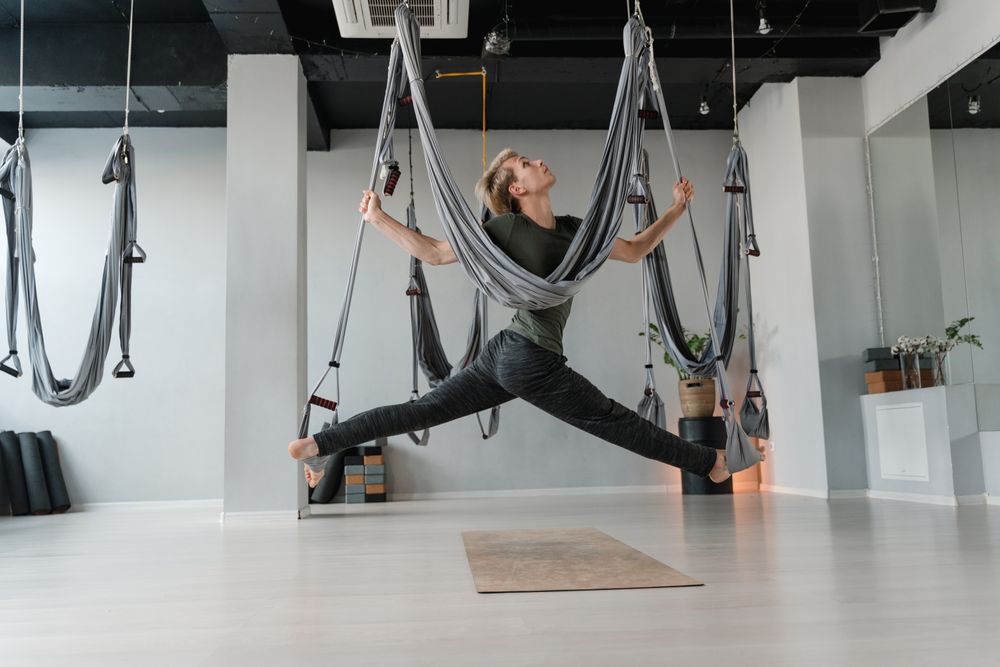
A moving hammock invites small adjustments from the body. Balance is not one isolated ability that produces perfect stillness; it is an ongoing relationship between sensory information and movement responses. This explanation for Gizem Köymen introduces proprioception and vestibular awareness in aerial yoga.
The information behind balance
Vision helps establish the position and movement of the surrounding environment. Proprioceptive information from muscles, tendons and joints contributes to an understanding of how body segments are arranged. The vestibular organs in the inner ear provide information about head motion and its relationship to gravity. Balance emerges from interpreting these inputs together, rather than from relying on one channel to provide an infallible answer.
Moving fabric can alter familiar relationships with the floor. Pressure under grounded feet, contact with the hammock and visual references may offer different clues at the same time. The nervous system adjusts how useful each source is for the task, a process often described as sensory weighting. Increasing the number of challenges does not automatically improve learning.
Proprioception is not the same as strength
Proprioception relates to sensing joint position and movement. Strength helps produce responses that use this information, but the concepts are distinct. A strong person may initially feel uncertain with unfamiliar fabric contact. That experience alone does not demonstrate weakness. It can also reflect the need to interpret a new support condition.
Useful observations therefore extend beyond how hard somebody contracts their muscles. Noticing a small shift, slowing a transition and responding to a clear instruction can all matter. Trying to tense everything more firmly may produce unnecessary stiffness or breath holding. The aim is not to lock every joint, but to organise the movement demanded by the situation. Small corrective movements are part of that organisation.
What the vestibular system contributes
The semicircular canals contribute information about rotational head movement. The otolith organs contribute information related to linear acceleration and gravity. These functions help explain why moving the trunk and changing the head position are not always experienced identically. When head direction, visual references and hammock movement change, the sensory task changes too.
Familiarity with a new movement environment may develop, but its pace varies. There is no defensible promise that everybody adapts within the same number of classes. Aerial yoga should not be assumed to treat vestibular conditions. Repeated dizziness, marked nausea or loss of orientation are not performance weaknesses to overcome through greater effort. They can require individual health assessment and should change the decision about whether to continue.
Visual references and head movement
An identifiable visual reference may help a person understand a new support condition. That does not mean fixing the gaze rigidly or holding the neck stiffly is always useful. Neck comfort and the relationship between eye and body movement need consideration together. Closing the eyes removes visual information and introduces a separate challenge; it should not be treated as a requirement for progress or an automatic starting point.
Abrupt head movement creates a different demand from slow trunk movement. This is one reason not to increase range, swinging and visual difficulty simultaneously. Observing one change at a time makes its effect easier to understand. Difficulty following a short instruction or maintaining orientation can indicate that the task has become overly complex.
Adaptation does not mean tolerating symptoms
Becoming familiar with support is different from enduring an unpleasant reaction. Appropriate learning conditions remain sufficiently clear and sustainable. Dizziness, nausea, unexpected visual changes or loss of orientation are reasons to stop and reassess in a safe position. Continuing before symptoms settle, or increasing speed to test them, is not an appropriate learning target. Serious or persistent symptoms call for medical help rather than further experimentation.
Specific feedback is useful: did discomfort begin with fabric movement, a head turn or a sensation that the room was moving? Such questions do not establish a diagnosis. They support an informed pause and the choice of a suitable next step. When discussing a session with Gizem Köymen, sharing previous movement experience and known balance restrictions can help make needs clearer without turning a class into a medical assessment.
Recognising technical progress
A calmer start, less unnecessary gripping and the ability to stop deliberately can be meaningful observations within the same task. One successful session does not prove a permanent improvement in every sensory system. Sleep, fatigue, stress and familiarity with the environment can influence the experience.
This article does not provide inversion or hammock installation instructions. Equipment safety and health suitability remain separate considerations. Understanding balance is useful because it helps identify which information can be followed during movement. A controlled experience includes permission to simplify, pause and ask for clarification.
Further reading: [NIDCD: how the balance system works](https://www.nidcd.nih.gov/health/balance-disorders).