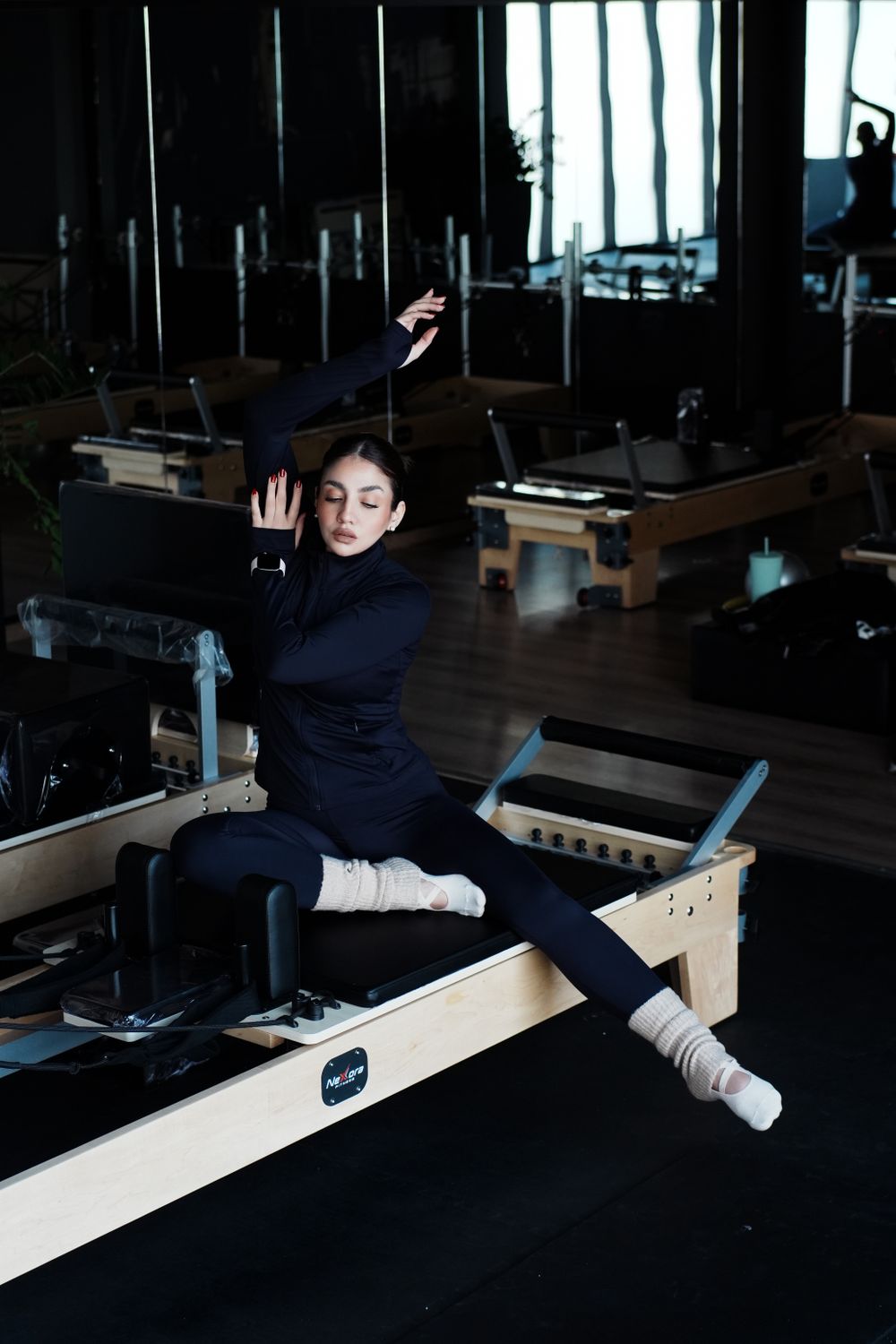
What to Know
When exploring Reformer Pilates with Gizem Köymen, spring colours and quantities may catch your attention. They cannot, however, explain the entire class experience. A spring creates a different mechanical relationship from holding a fixed weight. Its extension, the direction of carriage travel, the body’s support points and the attachments all matter. This article offers a framework for understanding those relationships rather than recommending a particular setting. The aim is to read the equipment’s role more clearly, instead of treating a larger number of springs as a sign of achievement.
Spring force is not the only mechanical influence on the carriage’s movement. The mass of moving parts, friction and the attachment arrangement can also affect the experience. Two machines with similar spring descriptions need not feel identical. Identifying the actual equipment makes a discussion about settings more informative.
Spring force is not the same as weight
Gravity acts on a weight in a downward direction. A spring produces force along its own line, related to the distance between its attachment points. In an ideal spring model, force increases with extension; actual equipment is influenced by initial tension, the spring used and the working range. The beginning and end of carriage travel may therefore feel different. A colour is not a universal kilogram equivalent shared by manufacturers. The particular machine’s system and instructions matter, rather than assuming that a similarly named spring elsewhere creates the same experience.
Ask which way the force acts
To understand whether a force opposes or assists movement, look at its direction. As the carriage travels one way, the spring may lengthen; during the return, it can draw the carriage towards its starting position. What this means for the person depends on which body part controls which task. Returning does not always mean resting, and moving away is not necessarily the only demanding phase. An observer can see the carriage path, but cannot identify every muscle’s role from that view alone. The purpose of the movement must also be understood.
More springs can also provide more support
Spring force can be resistance to overcome in one task and contribute support for the carriage or body in another. Adding springs does not make every movement harder in the same way. Fewer springs do not automatically mean beginner level either: a carriage that moves more readily can create a different control challenge. Force magnitude and the overall requirements of a movement are not interchangeable. Maintaining a position, managing carriage travel and coordinating support points cannot be reduced to spring force alone. Difficulty is not a single setting on a machine.
Pulleys, straps and body position
Straps and pulleys can change the direction in which force is transmitted. Sitting, lying or taking support in another position changes the body’s relationship with that force. This helps explain why two exercises using the same spring may feel different. The turning effect around a joint relates to force magnitude as well as its distance and direction. A longer lever or changing angle can alter the experience without changing the spring itself. These concepts are not an adjustment prescription; they provide useful language for understanding why different tasks receive different explanations.
Consider the whole carriage journey
Looking only at the end position leaves much of the process unseen. Speed and spring extension can change during the start, reversal and return. When listening to an explanation, ask what is intended to be controlled in each phase. Travelling farther does not, by itself, show that someone performed a movement with more control or purpose. A shorter path is not automatically less meaningful. Range, tempo, support and the task being emphasised become clearer when considered together. What a movement looks like and how it is experienced do not match one for one.
Technical questions for an introductory conversation
Ask how spring settings are explained, how newcomers meet the equipment and how the purpose of a movement is described. The equipment model, class content and participation format also belong in the discussion. Instead of copying another participant’s setting or a colour seen online, explore how the explanation relates to your own task. In a conversation with Gizem Köymen, share previous equipment experience and the questions you have. Understanding which force is involved and why is a more useful starting point than counting springs when deciding whether a Reformer experience interests you.